
Curious about a country most people don’t even know exists? Wondering where it is, what makes it special, and how to get there? This Comoros travel guide covers everything you need to know, from how to get there to what makes it worth visiting. Our adventure took us through Grand Comoros and the capital, Moroni, offering a deeper look at what travel here is really like. We share our insights on where to stay, where to eat and drink, and things to see and do. Our travel style is independent and immersive, with a focus on practical tips and useful things to know before visiting this obscure destination.
Some links may be affiliate, meaning we earn a small commission at no extra cost to you – this helps us keep sharing honest travel inspiration.
Comoros, ‘the perfume island’. Ylang-ylang, a key ingredient in perfume, is grown on the islands, hence the name. One of the least visited countries on earth, and notoriously difficult to reach, it’s a place most people have never even heard of — a true ‘lost land’. Made up of three main volcanic islands, sitting in the ocean between Mozambique and Madagascar, it has a forgotten feel about it. Home to beaches, rainforests, and ancient medinas, this little-known archipelago holds plenty of potential.
Why go to Comoros?
Comoros is an ideal destination for those who want to discover the undiscovered. It’s more than likely that you will be the only other traveller in the country, making it a unique place unlike just about anywhere else. There’s more of a Middle Eastern or North African atmosphere on the islands, where grand mosques, bustling medinas, and cats are the norm. Grand Comoros offers more of a cultural experience, while Anjouan and Mohéli provide a wilder, more natural adventure. Beaches, turtles, waterfalls, and spices can all be uncovered here, but it won’t be easy. There are no tours or well-trodden paths. It will be just you and the islands. This isolation is one of the number one reasons to visit the Comoros Islands.
Quick facts for travelling in Comoros
- Capital: Moroni
- Best time to visit: June to October (wet season December to April)
- Budget (mid-range couple): AU$150 per day
- Currency: Comorian Franc (KMF)
- Language: French
- Visa requirements: Yes (visa on arrival)
- Travel difficulty: 4 (1 = basic & 5 = challenging)
Moroni
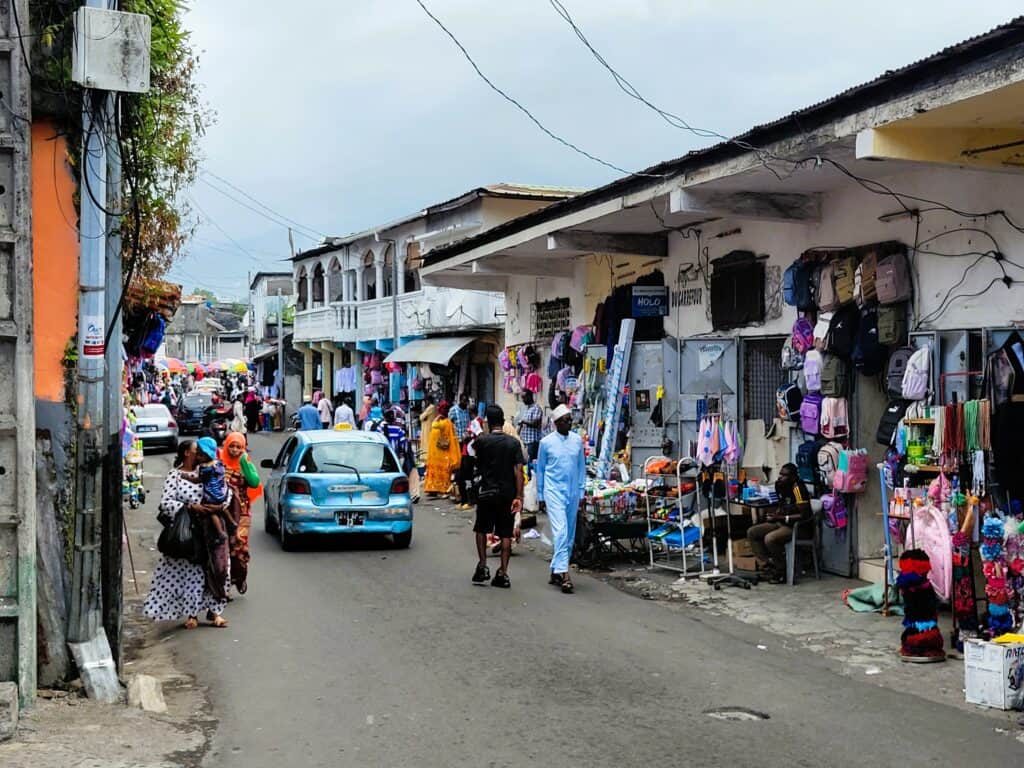
Moroni is a thriving metropolis – by Comoros standards, that is. The capital isn’t just the biggest city in the country; it’s the only one. Everything happens here. Ships come and go, flights arrive, and business deals unfold inside one of the many small buildings lining the tiny streets. Hugging both the shoreline and the slopes of Mount Karthala, Moroni is a calm place. Minarets dot the skyline, fisherman crowd the waterfront, and life moves on island time. This is the heart of the country.
Getting to Moroni
There is only a couple of ways to reach Moroni. The most common is the flight from Dar es Salaam, which operates a few times per week, or from nearby Mayotte. From Mayotte, there are onward connections to Paris and Madagascar. A weekly ferry also links the islands, sailing from Moroni to Mayotte with a stop at Anjouan. The journey takes around eight hours and can be rough.
Moroni Airport is a forty-minute taxi ride from the city. Expect to pay 20 euros. If you’re travelling light, you can walk out to the main road and wait for a shared taxi – a far cheaper, more local option.
Where to stay in Moroni
Moroni is not a city with abundant hotels and guesthouses. There aren’t a lot of options at all. Prices are generally high for what you get, and facilities can be basic due to limited local resources. The city centre is where you’ll find some basic hotel-restaurant type places, while quieter neighbourhoods on the outskirts offer a couple of fancier options, and a handful of Airbnbs. It’s not a large city, so wherever you find a suitable place is usually still convenient to points of interest.
Where to eat and drink in Moroni
Seafood and chicken are staples across the islands, usually served with rice. Nearly every dish includes some form of meat – even the rice pilau. Vegetarian options can be hard to find; accompaniments like boiled cassava, mataba (cassava leaves), and fried plantains are often the only choices. Fresh fruit and vegetables can be found in local markets or from street vendors. You’ll also come across plenty of cakes and freshly baked breads sold all over the islands — mkatra foutra is a soft coconut bread, while mkatra siniya is a sweet rice and coconut cake.
- Get to Café Dhow (tucked away off the busy street, this place has a good atmosphere, in a traditional Comorian home)
- Don’t miss Kinaza (good, simple, local-style food. Plenty of locals, quick service, friendly staff, and reasonable prices. You won’t find it on Google maps. It’s 100m from the Retaj Moroni Hotel)
- Check out Moroni Tennis Club (serves tasty dishes. The restaurant of choice for expats and foreigners)
Things to see and do in Moroni
Museum of Comoros sits in a large white building next to Exim Bank. The small museum has a modest collection of artefacts that trace the islands fascinating history.
The Medina is one of the busiest parts of the city. Locals come here for daily essentials. You’ll find everything from clothing and spices to household goods.
Mosques are scattered throughout Moroni, with the largest, Badjanani Mosque, located along the waterfront. Fridays are a special day, and witnessing a mass prayer is memorable.
Volo Volo Market and its surrounding streets are a jumble of stalls, wheelbarrows, traffic, and blaring noise. Navigating your way through may be a challenge, but that’s all part of the fun.
Bichyoni Palace Ruins were once home to the islands ruling sultans. Today, a handful of crumbling stone structures remain, some with information signs in French, others reduced to piles of rock.
Iconi Village is a quiet seaside settlement to the south of Moroni. It’s a nice place to wander around, looking for ruins of the old sultan’s palace. There’s also an impressive mosque.
Mount Iconi offers lovely views over the village and back towards Moroni. There was once a grand mosque up here, parts of it still remain today, including the rampart-like walls and several stone gates.
Itsandra Beach is a local favourite, especially in the evenings when crowds gather to watch the sun set over the Indian Ocean.
Centre Commercial Comorian is a small store selling locally made goods, such as coffee and vanilla. The guy that runs it is super friendly.
The Tourist Information Centre has a couple of maps and leaflets available – they are in French. One staff member spoke a little English.
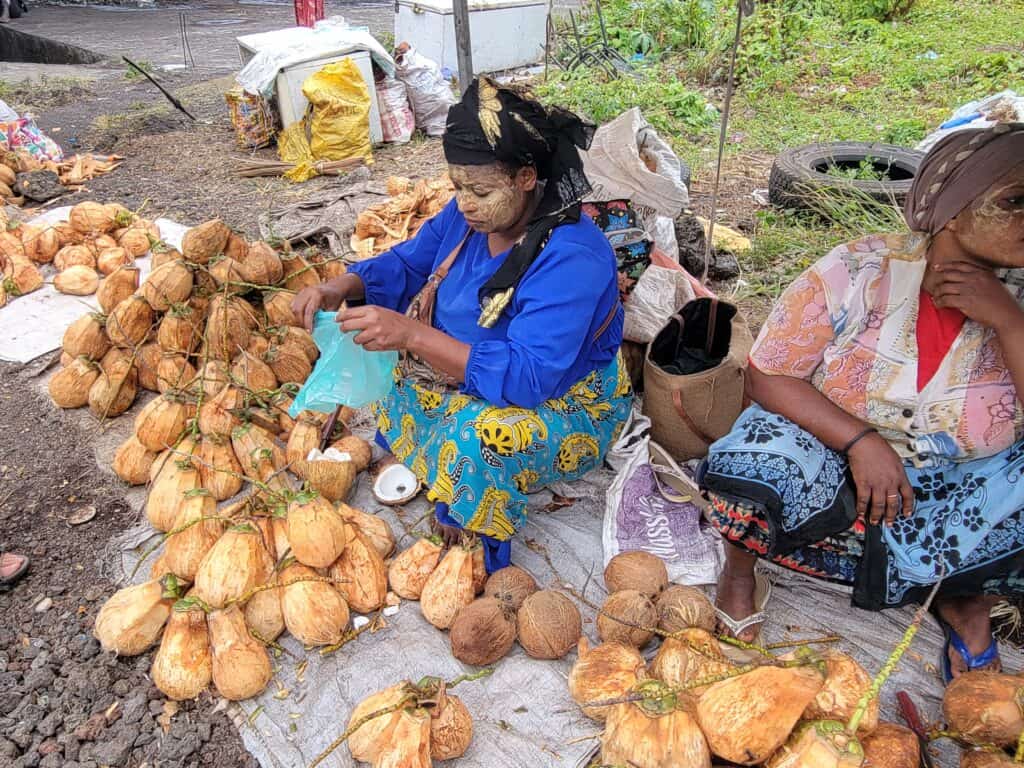
Immerse yourself with the local Comorians by simply walking around your neighbourhood. Stop to buy a coconut pancake, greet people you meet, and soak up daily life. English is rarely spoken, and locals can be shy at first, but they are warm and welcoming.
Grand Comoros is small enough to drive around in a day, and along the way, you’ll encounter ruins, historic landmarks, fishing villages, and scenic beaches. The neighbouring islands of Anjouan and Mohéli are accessible by ferry or private boat. Both are covered in lush forest and natural beauty, offering a wilder, more remote experience – though facilities are basic.
Getting around Moroni
Shared taxis are the public transport of choice. They have a taxi sign on their roof, and are easy to find. If they have space, they’ll stop when you wave. Tell them where you want to go, and if they are going that way, jump in. Minivans depart from various locations in the city. These head to villages around the island. Walking around the city is easy enough, although you will be sharing the road with traffic, so be careful.
Come to Comoros to show that these islands – and their people – are not forgotten.
Getting to Comoros
Comoros is not an easy place to reach. In fact, you can only fly here from Dar es Salaam or Mayotte. It takes some planning and time. A ferry also connects Grand Comoros with Mayotte, along with neighbouring islands Anjouan and Moheli.
We travelled here from Dar es Salaam, Tanzania. We departed on the flight to Mayotte.
Useful things to know before visiting Comoros
Cash is king. Card payments are non-existent.
Euro is the best foreign currency to bring.
EWA Airlines connects Comoros with Mayotte, but they’re notorious for last-minute cancellations and sudden changes to departure times. We experienced two flight cancellations and three schedule changes ourselves! On top of that, their baggage rules can be quite unusual.
Visa on arrival is easy to obtain, but can only be paid for in euros.
There’s no ATM or currency exchange at the airport.
ATMs are unreliable, and don’t except all international cards.
It’s not a cheap destination, so plan your budget accordingly.
It is an extremely safe country.
It’s hot.
There’s a noticeable waste problem on the islands.
There are regular power cuts.
Not many people speak English. Try and find a host who is bilingual.
Final thoughts on travelling in Comoros
Comoros is a place to come without any expectations. It’s not the type of place to come with dreams of a paradise beach getaway. There are bigger issues to solve before tourism can flourish. Many people here lack access to fresh water, and waste management is a problem that is out of control. The Comoros are indeed ‘lost islands’, under the radar from the rest of the world, but they cannot be forgotten or neglected. They need and rely on international support. Almost everything is imported, making it a difficult place to live and to travel. Life here has many challenges, but live here they do. They know nothing or anywhere else. This is it. They would love to travel, move or study abroad. Sadly, it’s out of reach for many. It’s a country with so much potential, yet with so much work to be done.
Visiting the islands, meeting the people, and sharing your experiences when you return home is just the first step in the long journey Comoros has ahead. Every journey starts with a single step. Come to Comoros to show that these islands – and their people – are not forgotten.
After exploring Comoros for ourselves, it’s easy to see why it featured in our post: Obscure Destinations to Visit in 2025